






Publicité

Image

By Anthony Leung Shing, Country Senior Partner, PwC Mauritius
Mauritius has, in recent years, grappled with the challenge of balancing economic growth, social cohesion and fiscal sustainability. Budget 2026/27 underscores how complex this balancing act has become. Against a difficult global backdrop marked by geopolitical tensions and heightened uncertainty, the economy has remained resilient, expanding by around 3% in 2026. At the same time, public sector debt remains close to 90% of GDP, inflation continues to weigh on household purchasing power and external vulnerabilities persist. Combined with weaker-than-expected revenue performance and the absence of anticipated Chagos-related inflows, these factors have left the Government with limited fiscal room to pursue its economic and social objectives.
The Budget sets out a vision of transforming Mauritius into a future-ready economy through a startup revolution, the modernisation of strategic infrastructure, the development of the blue economy and measures aimed at addressing investment constraints. Startup incentives are a welcome step for an economy where SMEs play a central role, with further scope over time to strengthen Mauritius’ appeal to international entrepreneurs, startups and venture capital. Likewise, investments in the island container terminal and airport infrastructure should enhance trade efficiency, connectivity and the country’s competitiveness. In the blue economy, the focus on research and aquaculture is encouraging and provides a foundation for broader sector development. Building on these initiatives by attracting international operators and investment into marine concessions and ocean-based industries could further accelerate growth, bring specialised expertise and expand export opportunities. While these initiatives hold significant long-term promise, translating ambition into economic outcomes will require far greater investment, skills and institutional capacity than currently available, making sizeable short-term gains unlikely
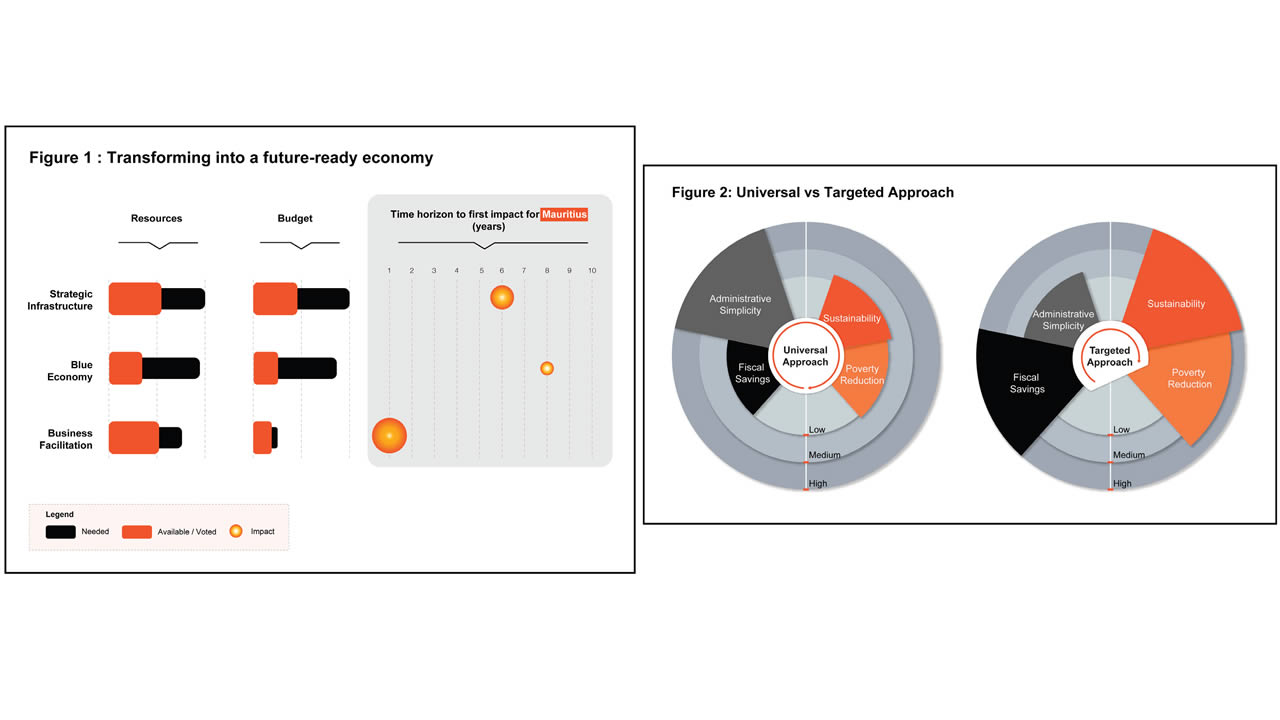
The more immediate growth opportunity lies elsewhere. Mauritius does not suffer from a shortage of economic strategies; it suffers from a shortage of implementation. Dismantling investment constraints and improving institutional efficiency can deliver faster and more tangible results than many of the longer-term initiatives announced. Faster permit approvals, streamlined work permit processes, greater digitalisation and regulatory simplification can unlock private investment, boost productivity and strengthen competitiveness at relatively low cost and with a much quicker impact on growth (refer to Figure 1 in attachment).
On the fiscal front, the Budget takes important steps towards consolidation, most notably through pension reform and the introduction of the new State Age Pension scheme. While the full mechanics remain to be assessed, the tapering of benefits for higher-income earners restores a degree of equity to the system, while the alignment of public officers’ pension arrangements sends a positive signal of shared responsibility. Pension expenditure is projected to decline by nearly 12% to Rs 68.1 billion by 2028 compared with the previous system, representing a positive step towards improving fiscal sustainability. Nevertheless, pensions will remain a significant component of public expenditure for years to come.
At the same time, the Budget maintains its commitment to supporting household purchasing power through the introduction of the Purchasing Power Shield on selected food items. These measures provide broad-based relief at a time when many households continue to face cost-of-living pressures. The price tag: subsidy expenditure is set to double to Rs 6.2 billion next year. Looking ahead, there may be scope to further enhance the effectiveness of social spending by gradually complementing universal support measures with more targeted forms of assistance. Such an approach could help direct resources towards the most vulnerable households while generating fiscal savings that strengthen the long-term sustainability of public finances. Although more demanding from an administrative perspective, a targeted approach can often achieve stronger poverty-reduction outcomes at a lower fiscal cost than universal schemes (refer to Figure 2 in attachment).
The Budget also introduces several measures to strengthen Mauritius’ attractiveness as a hub for talent, investment and innovation, including a comprehensive migration policy, an e-Diaspora platform, a framework to attract world-class universities and post-study work visas for foreign graduates. The Special Economic Zone at Côte d’Or further supports this ambition by targeting investment in AI, digital industries and advanced manufacturing. However, labour shortages remain a significant constraint on growth, and the introduction of a 35% top marginal tax rate risks making Mauritius less attractive to the highly skilled foreign professionals and specialised expertise required to support its economic transformation.
This Budget will ultimately be judged not by the breadth of its ambitions, but by the effectiveness of its execution. The theme, “The future depends on what we do in the present”, captures this challenge well. The priority now is to translate fiscal discipline and structural reforms into stronger, more inclusive and sustainable growth. Success will depend less on new policy announcements and more on the Government’s ability to deliver practical reforms that remove bottlenecks, unlock investment and restore confidence among businesses, investors and households.
Image
Quelle est votre réaction ?
 J'aime






Publicité