







Publicité

Image
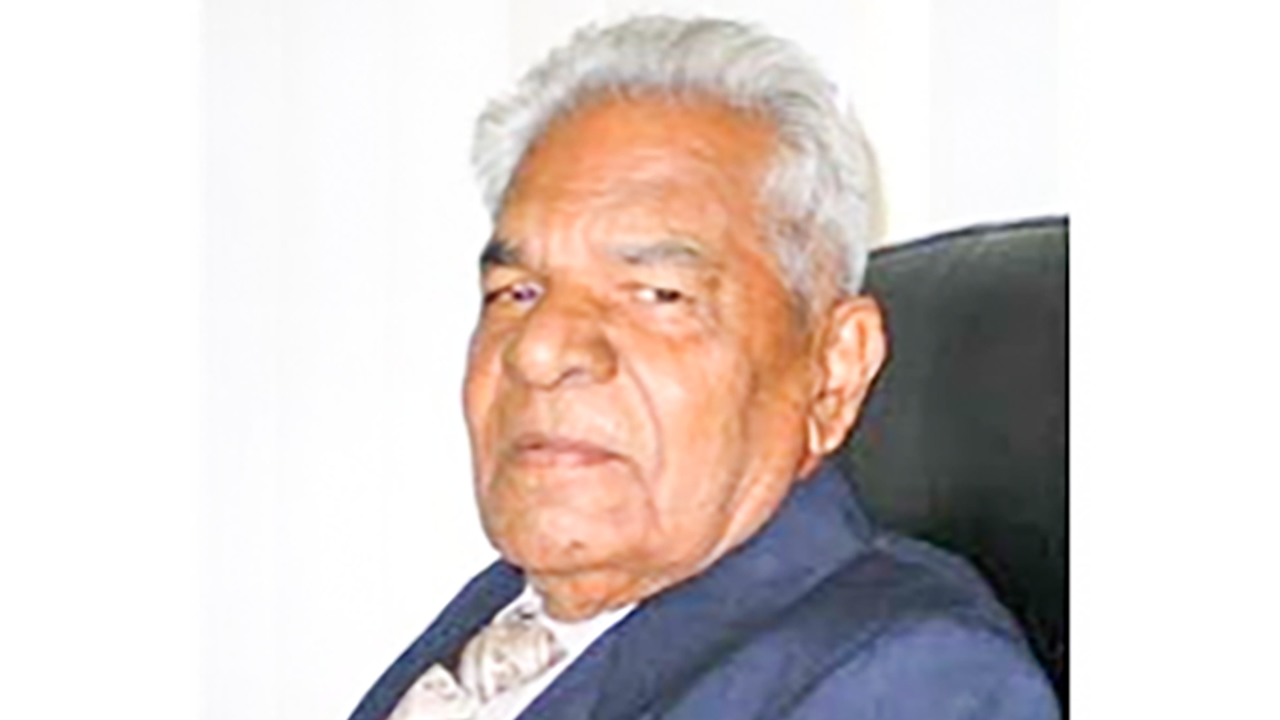
Former Financial Secretary and Cabinet Secretary Madhukarlal Baguant passed away quietly, leaving behind a legacy of integrity and an exceptional professional journey.
I was woken up early Thursday 12th February by my aide with the tragic news that you had moved on the night before at the clinic, barely hours after you had been admitted there with a persistently high temperature. He had been liaising with your sister-in-law to agree on a convenient slot when I could pay you a visit. It was not to be, not in this world.
You left us, exactly as you had lived. Quietly. Discreetly. Surrounded until your last days by the warmth and comfort of your family in the house that you had bought in Quatre-Bornes from a departing resident who preferred to migrate to Australia rather than face the uncertain prospects of the soon-to-be independent Mauritius.
Madhukarlal Baguant was born in August 1935, to Roheeneenundun Baguant and his wife Chundraootee Geerjanan, as the 6th of ten siblings. He grew up, together with his three sisters and six brothers in the family house in Phoenix. His maternal grandparents were not far away, in Highlands. His uncle and aunt were settled in the Baguants’ native village of Cam-Ithier where he had cousin siblings.
He spent quality family time in all three places, playing, socialising, swimmimg in the rivers, which he loved. Unfortunately, he lost his father when he was only eight years old. His elder brothers and the extended family stepped in to ensure that the family’s needs were adequately taken care of.
Madhu did most of his early schooling at Camp Fouqueraux primary school, finishing the primary cycle with Standard VI at the St Enfant Jesus Roman Catholic Aided School in Rose Hill, a star school then as now. He was an assiduous student and benefited fully from the family tutoring system run in-house by the elder siblings.
As expected, he went to the Royal College of Curepipe for his secondary studies. The teenager Madhu must have impressed his teachers considerably as he was one of three students selected to progress from Form I straight to Form III, skipping Form II altogether.
He continued with his turbo-charged performance in the upper Forms, which was captured in a newspaper of 30th September 1954, in an article entitled “L’Histoire du Centre Administratif de Curepipe”, as reported in the following extract half a century later. “La presse, d’il y a un demi-siècle, fait la part belle aux résultats scolaires de la GCE Advanced Level. Ils font mention des succès de Madhukarlal Baguant en mathématiques, mathématiques appliquées, physique, et chimie.”
It was no surprise, therefore, that he joined the Central Statistics Office when he left college, where he learnt on the job, like several others of his peers while taking the several stages of the professional exams that would qualify them as full-fledged statisticians. For Madhu, this was only the first rung of a ladder that would eventually take him to the top echelons of the Civil Service.
He was married in 1961 to Miss Narbada Hoolsy, daughter of an agricultural landowner from their neighbouring native village, who was active in the co-operative movement. Two years later, he obtained a Commonwealth Scholarship which took him to Canada where he studied Economics at the University of Manitoba and graduated in 1966.
Our paths crossed in February 1969 when the two of us were selected by the Public Service Commission, after interview, to be appointed as economists in the Economic Planning Unit of the Prime Minister’s Office. Our trajectories diverged when I took leave of absence to join the United Nations Industrial Organization in Vienna for some years only to return after the EPU had become a full-fledged Ministry in its own right. The Minister, Sir Kher Jagatsing, was heard to pun: “I’ve got two great guys: one is Bheenick, the other is a cynic!» He was referring to Madhu, of course.
Madhu was Deputy Director and I occupied the next slot as Secretary for Aid Coordination until the bust-up leading to devaluation and structural adjustment with IMF and World Bank Programs in end-1979. He became Financial Secretary in January 1980, and I was appointed Director of MEPD, effectively running in double harness as we set about the arduous task of repairing the damaged economy and enhancing its prospects.
We stayed the course, both the country and the two of us who played a stewardship role through an all-change in government and several break-ups in ruling coalitions thereafter. We were hauled before investigations and Commissions of Inquiry under strenuous personal circumstances, with heavy clouds hanging over our career prospects. The clouds lifted gradually.
Madhu redefined the Financial Secretary position into a much-coveted post. He was unceremonially shunted aside against his wishes to the administratively higher position of Secretary to the Cabinet. I accompanied him to call on the outgoing Cabinet Secretary where Madhu declined the promotion and asked to stay in his post, only to be told that the post was already filled. This is how Madhu became an unwilling Cabinet Secretary. He went on nevertheless to serve with dedication, leaving a spotless reputation when he retired from this position in 1995.
He served on the board of many government-linked corporations and institutions, too numerous to mention, during his long career. He chaired several financial institutions such as the Development Bank, State Investment Corporation, State Bank of Mauritius, and State Bank of India (Mauritius branch).
After retirement, he went on to serve as full-time Chairman of the Central Tender Board for two terms. His last role was to chair the body that replaced it, the Central Procurement Board, in 2015 until hanging up his spurs in 2018.
Madhu was a tireless over-achiever, a worthy scion of a family that gave him brothers who were Government Principal Dental Surgeon, Dental Surgeon, Director of Civil Aviation, Hospital Physicist, Agricultural Researcher and Head of the Philately Section of the Post Office. His cousin siblings included an Attorney, a laureate who became a medical doctor, and a Pro Vice-Chancellor of the University of Mauritius.
A grateful State conferred on Madhu the status of Commander of the Order of the Star and the Key, CSK. The French Republic made him a Chevalier de l’Ordre National du Mérite.
An illustrious career to be proud of, for all his family, relations, colleagues, and friends who mourn his loss. Madhu leaves behind three daughters, a son, two sons-in-law, a daughter-in-law and six grandchildren. His wife had predeceased him.
Our deepest condolences go to all of them.
Farewell, my friend.
Manou Bheenick
Quelle est votre réaction ?
 J'aime






0
0
0
0
Publicité
Translate to creole
Désactivé
length
6689
Translation Status
Auto Translate Pending