
Publicité
[Blog] AI Impact Summit : AI for People, Planet, and Progress
 Par
Guest .
Par
Guest .
Publié le:
20 février 2026 à 10:36





 Par
Guest .
Par
Guest .
1. From rural farms to courtrooms, Artificial Intelligence is quietly transforming how 1.4 billion Indians live, work, and govern themselves. India is fast emerging as one of the world’s most ambitious architects of Artificial Intelligence – not merely as a commercial enterprise, but as a national mission to lift hundreds of millions of its citizens into a more prosperous future.
2.Ind4ia now ranks third globally in AI competitiveness, according to Stanford University’s 2025 Global AI Vibrancy Tool. It is also one of largest contributor to AI projects on GitHub.
3. Yet the numbers tell only a part of the story. The ultimate objective is welfare, progress, and inclusive development. India is working to ensure AI services not only for its engineers and entrepreneurs, but also for farmers, informal workers, students, and patients.
4. At the heart of India’s AI push is the IndiaAI Mission with the guiding motto, “Making AI in India and Making AI Work for India». This Mission rests on seven pillars which span from affordable GPU access, application development, datasets, homegrown foundational models, skilling, startup financing, to AI safety. Together, they form an end-to-end architecture designed to take AI from raw infrastructure all the way to responsible, large-scale deployment.
5. Its most tangible early achievement has been computing power. The AI Mission originally targeted 10,000 Graphics Processing Units (GPUs). It has already surpassed that number deploying 38,000 GPUs.
6. India is using AI to celebrate its linguistic diversity. Spanning 22 officially recognised languages and hundreds of dialects. BharatGen AI, launched in 2025, is India’s first government-funded multimodal large language model. It supports 15 Indian languages and integrates text, speech, and image understanding. Built on domestic datasets, it captures this diversity in ways that only an India grown model can.
7. For India’s farming households, AI is becoming a digital companion in the truest sense. The Ministry of Agriculture’s Kisan e-Mitra virtual assistant helps farmers access government schemes. The National Pest Surveillance System integrates satellite, weather and soil data to deliver actionable crop health advice.
The A.I. Impact Summit reflects our shared commitment to scaling innovation responsibly for a brighter, and more humane future.
8. And in the justice system, the e-Courts programme is using machine learning, language technologies, and optical character recognition to translate judgments into regional languages, enable automated case scheduling, and deploy AI chatbots for legal guidance.
9. In healthcare, AI-powered telemedicine platforms are extending the reach of specialists to remote areas and connecting rural patients with urban hospitals. In education, the National Education Policy 2020 encourages AI skill development and the DIKSHA digital learning platform uses accessible AI features to visually impaired learners. The YUVAi programme is teaching students to apply AI across eight real-world themes, from smart cities to legal aid, nurturing the next generation of problem-solvers.
10. The most sobering part of the AI challenge is ensuring that the world’s largest informal workforce benefits from this transformation rather than being displaced by it. Policymakers, including NITI Aayog, which is Indian Government’s policy think tank, have emphasized the need for inclusive AI strategies that draw on the lived experiences of this workforce- be it a home healthcare aide in Rajkot, a carpenter in Delhi, or thousands of farmers across the country- using their stories to map the barriers that technology must overcome if it is to serve them, to include them and make them part of India’s growth story.
11. India is not building this ecosystem in isolation. As you read this, we are hosting the AI Impact Summit which showcases our AI capabilities to the world. The Summit’s emphasis on women leaders, the Global South, and differently-abled innovators signals the kind of AI future India wants to shape – one that is inclusive by design. From across the world, leaders have joined to deliberate on A.I and its future – in the world and for the world.
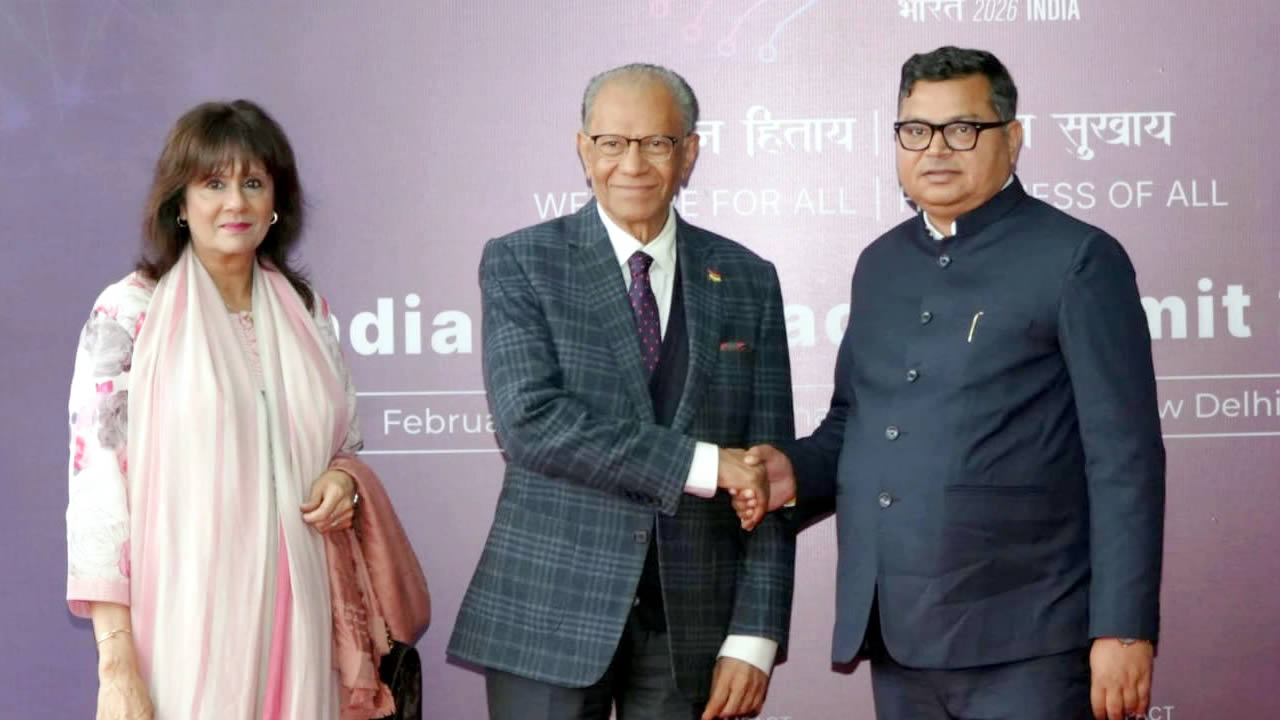
12. Prime Minister Dr. Navinchandra Ramgoolam’s presence at the Summit underscores India and Mauritius’ shared commitment towards leveraging technology for progress and well-being of our peoples. Our shared intentions are clearly outlined in our Joint Vision for Enhanced Strategic Partnership wherein Digital Cooperation forms one of the key pillars. We continue to share our technological advancements with Mauritius both as a close partner in the Indian Ocean Region and in the wider Global South. Alongside Mauritius, we are working on digitising the judiciary, launching a joint satellite, and developing softwares to help with weather predictions and climate analysis.
13. India’s direction is clear, and the scale of investment is real. A significant proportion of the Start Ups in India are using AI in their products and the AI talent base is expected to exceed a million professionals by 2027.
14.India is building the human and institutional capital required for long-term AI leadership. The A.I. Impact Summit reflects our shared commitment to scaling innovation responsibly for a brighter, and more humane future.
By H.E Anurag Srivastava, High Commissioner of India to Mauritius
 J'aime